









Solar lead generation is how an installer gets homeowners to request a quote. It runs through own marketing, such as Google Ads, SEO and Meta ads, or through bought solar leads. See how we run follow-up email for solar companies in our solar email marketing service.
Own marketing gives you control and exclusive leads, while bought leads give speed and shared contacts. Our lead generation services start from the same rule: pay only what your close rate and install profit allow.
- Own marketing builds leads you do not share. Bought solar leads are faster but often go to several installers.
- Set a ceiling price per lead from your close rate and gross profit per install, then hold every source to it.
- Paid search clicks for solar lead terms run about $10 to $16 each (Ahrefs, US, 2026), so landing pages and follow-up matter.
- Speed to first call decides who wins the appointment.
To generate solar leads, set a cost ceiling, run Google Ads, build solar SEO pages and call every lead within minutes. This guide is for solar installers deciding between their own marketing and bought leads.
You need a quote form, a phone that is answered, and a budget you can hold for 90 days. Free steps cost time, and paid steps cost an ad budget that you pay to Google or Meta directly.
What you need first
You need a ceiling price per lead, a tracking sheet, a landing page and a person who calls leads fast. These four items keep your spend tied to signed installs.
Check each item:
- A close rate and a gross profit per install. Pull them from your last 20 quotes.
- A tracking sheet. Record source, date, call time, appointment and signed or lost.
- A landing page for solar quotes. One offer, one form and one phone number, like our solar web design pages.
- A follow-up owner. One person is responsible for every lead call.
Should you buy solar leads or generate your own?
Generate your own leads when you can hold a 90-day budget and track results. Buy leads when you need volume this month and the price fits your ceiling. Many installers use both and compare the cost per signed install.
| Factor | Own marketing | Bought solar leads |
|---|---|---|
| Who else gets the lead | Only you | Often several installers |
| Speed to first lead | Slower to build | Fast |
| Control over message | High | Low |
| Cost pattern | Ad budget plus management | Fee per lead |
| Best for | A steady pipeline | Filling a gap |
Own marketing compared with bought solar leads, 2026.
Use this rule for any lead price. The most you should pay is your close rate times gross profit per install, halved to leave profit.
Sample math with made-up numbers: if a bought lead closes at 5% and an install leaves $4,000 in gross profit, the cap is $100. If your own exclusive lead closes at 10%, the cap is $200. Use your own numbers.
Steps for solar lead generation
These 7 steps run from the foundation to the paid channels. Do steps 1 and 2 before you spend on ads.
1. Set your cost ceiling and tracking
Work out the most you can pay per lead and per signed install. Every later choice depends on these two numbers.
How to do it:
- Divide signed installs by leads to get your close rate for each source.
- Multiply by gross profit per install and halve the result.
- Log source, call time and result in one sheet.
Checkpoint: each lead source has its own ceiling. A lead value calculator does the math from your close rate.
Mistake to avoid: comparing sources by cost per lead alone, instead of cost per signed install.
2. Build a solar landing page that earns the quote
Use one landing page with one offer and one form. A page built for one action keeps the visitor focused, unlike a home page with ten links.
How to do it:
- Lead with the homeowner’s goal: a lower power bill and a clear quote.
- Explain financing offers in plain words and link no more than one.
- Add a short form and a click-to-call button above the fold.
Checkpoint: the page loads fast on a phone. Mistake to avoid: asking for ten fields before a quote.
3. Run Google Ads on solar quote searches
Bid on searches that show buying intent, such as solar installers near me and solar panel cost. Paid search reaches homeowners who are ready to ask for a quote.
How to do it:
- Target your real service area and your licensed states only.
- Group ads by intent: cost, install, financing and local installer.
- Send each ad group to a matching landing page.
Checkpoint: cost per lead stays under your ceiling after the learning period. Our Google Ads for solar and solar PPC management pages explain the setup. Stand-alone Google Ads management is $999 a month plus your ad spend, paid to Google.
In a BRD client campaign for a bathroom remodeler, conversions rose from 4 to 21 and cost per lead fell 43.66%. We switched bidding and narrowed locations. Read the case study. It is a result from another home service trade, not a solar result.
Mistake to avoid: bidding on broad terms like solar, which brings in students and researchers.
4. Build solar SEO pages for local intent
Write one page per service and per city you serve. Organic pages bring in leads at no click cost after they rank.
How to do it:
- Create pages for residential solar, battery storage and commercial solar.
- Add a page for each main city or county you install in.
- Keep your business profile and reviews current with local SEO.
Checkpoint: each page answers cost, process and timeline questions. Our solar SEO and AEO for solar companies pages show the structure.
Mistake to avoid: copying manufacturer text that every installer already uses.
5. Use Meta ads for awareness and retargeting
Run Facebook and Instagram ads to reach homeowners before they search. Meta works best with a simple offer such as a free savings estimate.
How to do it:
- Use one real install photo and one clear offer.
- Target homeowners in your service area.
- Retarget visitors who left the quote form unfinished.
Checkpoint: track cost per lead and appointment rate separately. Meta ads management is $1,999 a month plus ad spend; see Meta ads for solar.
Mistake to avoid: judging Meta by quote forms alone, since many leads need a call to qualify.
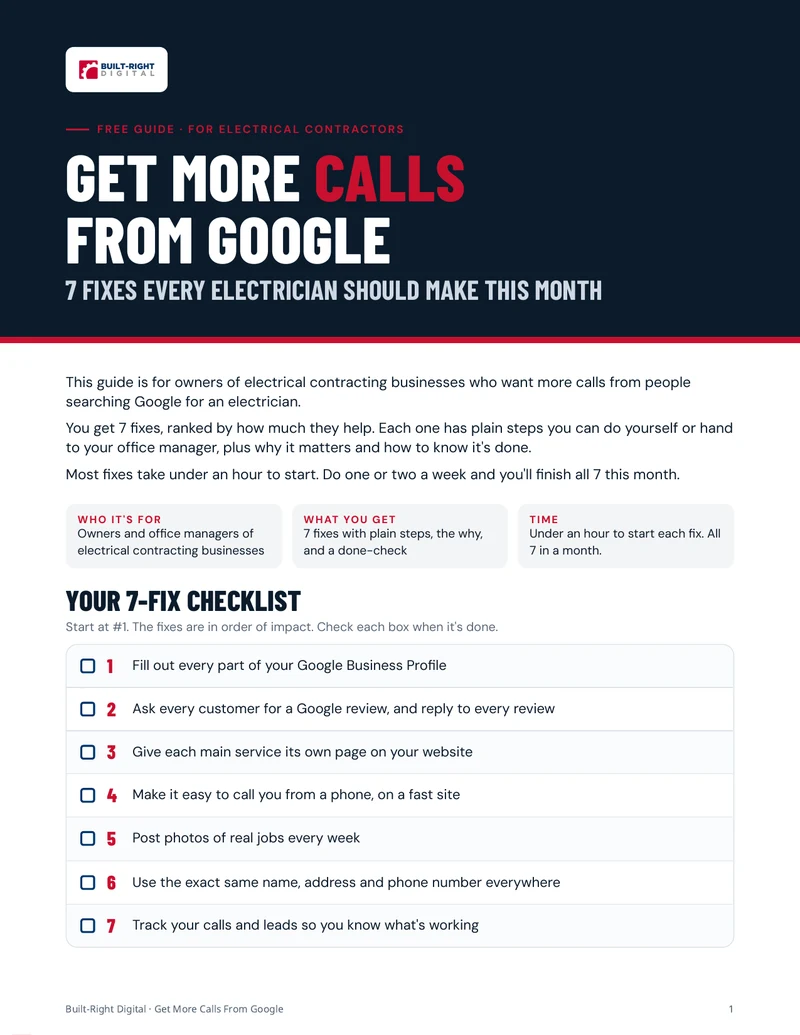
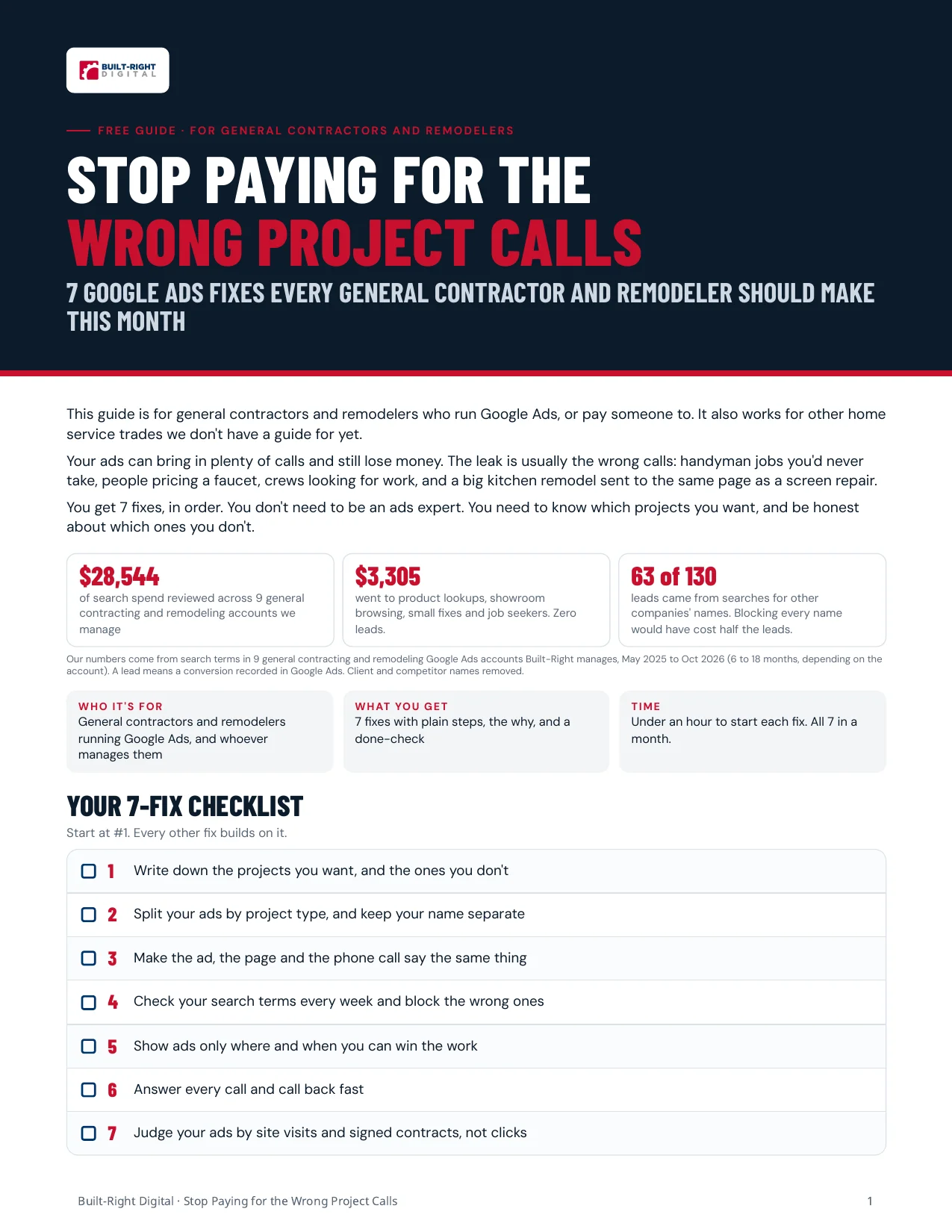
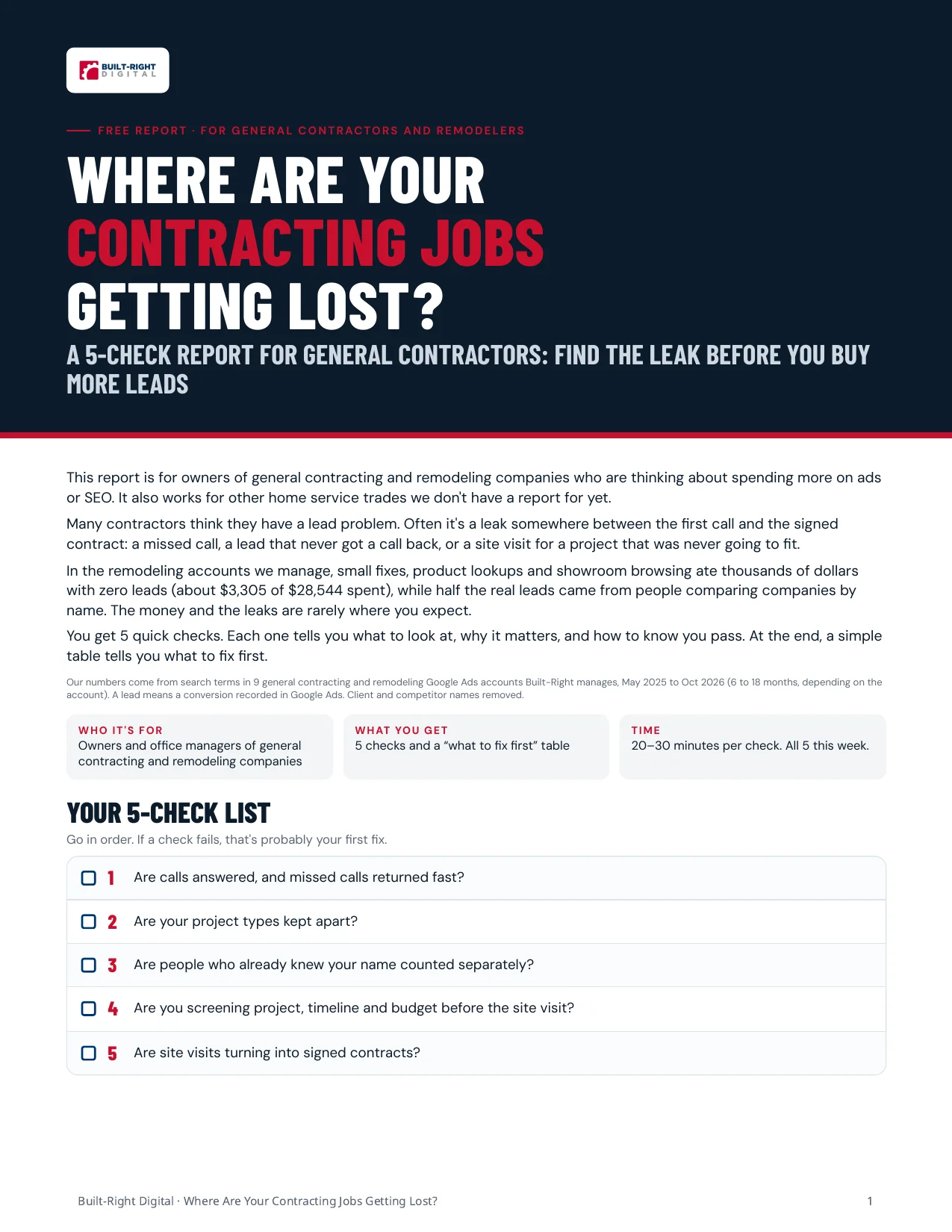
Get the free contractor marketing guide
Get practical marketing steps to bring in better leads with the free Built-Right guide.
Get the free guide6. Add exclusive leads or appointment setting if you need volume
Buy exclusive leads or use an appointment setter only when the price fits your ceiling. Exclusive leads go to one installer, so your close rate is higher than on shared leads.
How to do it:
- Ask each vendor whether the lead is shared and with how many installers.
- Run a 30-day test with a fixed lead count.
- Compare cost per signed install with your own Google Ads.
Checkpoint: stop any vendor that stays above your ceiling. Mistake to avoid: signing a long contract before the 30-day test finishes.
7. Follow up in minutes and qualify on the first call
Call every lead as soon as it arrives and ask four questions. Speed matters because homeowners may request quotes from several installers.
How to do it:
- Call within minutes, then text if there is no answer.
- Ask about the roof, the power bill, the home owner and the timeline.
- Book the appointment before you end the call.
Checkpoint: every lead has a call time logged. Mistake to avoid: sending a quote by email with no call.
How do you know solar lead generation is working?
Solar lead generation is working when cost per signed install stays under your ceiling and call speed stays fast. Review five numbers monthly and change one thing at a time.
| Metric | Target | Where the target comes from |
|---|---|---|
| Cost per lead | Under your ceiling | Your close rate times gross profit, halved |
| Time to first call | Minutes | Your own rule |
| Appointment rate | Set a baseline, then raise it | Your own tracking |
| Close rate | Your own number by source | Your last quotes. Our clients average 40% across trades |
| Cost per signed install | Below gross profit per install | Your own numbers |
Targets for a solar lead plan. Built-Right Digital client data, 2026. Solar results will differ.
Maximum price per lead = close rate x gross profit per install, halved. Check it for every lead source each month.
Common solar lead problems and fixes
Most solar lead problems trace back to slow calls, weak landing pages or shared leads. Each one has a quick fix.
| Problem | Likely cause | Fix |
|---|---|---|
| Leads do not answer | Another installer called first | Call within minutes and text right after |
| Quotes do not close | Weak first-call qualifying | Ask about roof, bill, ownership and timeline |
| Cost per lead is high | Broad keywords or a wide area | Narrow to your service area and buying terms |
| Bought leads are duplicates | Shared lead sold to many | Ask for exclusivity in writing or drop the vendor |
| Ads get clicks but few forms | Weak landing page | Use one offer, one form and click-to-call |
Common solar lead problems, causes and fixes.
Want solar leads you can count on?
Contact us and we will review your landing page, ads and follow-up, then show you what to fix first.
Contact usSolar lead generation FAQ
How do you generate solar leads?
Generate solar leads by running Google Ads on quote searches and building local solar SEO pages. Add Meta ads for reach and call every lead within minutes. Send each source to a dedicated landing page and track cost per signed install. Buy leads only when the price fits your cost ceiling.
How much do solar leads cost?
Solar lead prices vary by state, whether the lead is shared or exclusive, and how well it is qualified. Instead of trusting an average, set your ceiling: close rate times gross profit per install, halved. Paid search clicks for solar lead terms run about $10 to $16 each, according to Ahrefs.
Should I buy solar leads or generate my own?
Buy solar leads when you need volume now and the price fits your ceiling. Generate your own when you can hold a 90-day budget and want exclusive leads. Many installers run both and compare cost per signed install each month to decide where to put the next dollar.
Are exclusive solar leads worth it?
Exclusive solar leads can be worth it because only you call the homeowner, which raises your close rate. They cost more, so test a fixed number for 30 days. Keep the vendor only if cost per signed install stays under your ceiling.
What are the best solar lead generation companies?
The best solar lead generation company is the one that keeps your cost per signed install under your ceiling. Ask each vendor if leads are shared, how they are qualified and what the refund policy is. Test before you sign, and compare vendors with your own Google Ads results.
How fast should I follow up with a solar lead?
Follow up within minutes. Homeowners may request quotes from several installers, so a fast, useful call gives you the best shot at the appointment. Call, then text if there is no answer, and ask about the roof, the power bill, ownership and timeline before you book the visit.
Final advice
Set your cost ceiling first, then pick one paid channel and one organic channel to test for 90 days. If you want help, a home services marketing agency can build the landing pages, run the ads and track every lead to a signed install. See our work and the pricing page for plans, and marketing for solar companies for the full service.
Related articles
Roofing lead generation guide →
Lead sources for roofing companies.
Website design for home services →
Pages built to turn visits into calls.
Google Ads management →
How we run Google Ads for home service businesses.
Meta ads management →
How we run Facebook and Instagram ads.